Why First-Time Car Buyers Are Choosing Used C ..
Nov 19 - 2026
Buy Car: +91 99090 06000 | Sell Car: +91 98250 60556 | Car Care & Modification: +91 98250 20746
19
Nov
India now buys more used cars than new ones, and the gap is widening. Two major reports released in 2026, one by Crisil Ratings and one by Redseer Strategy Consultants, show a market that is growing fast, getting younger and slowly becoming more organised.
This post pulls out the numbers that matter and explains what they mean for anyone buying a pre-owned car in Ahmedabad or elsewhere in Gujarat.
|
Metric |
Figure |
Source |
|---|---|---|
|
Market value, FY26 |
About $35 billion |
Redseer, April 2026 |
|
Projected market value, FY31 |
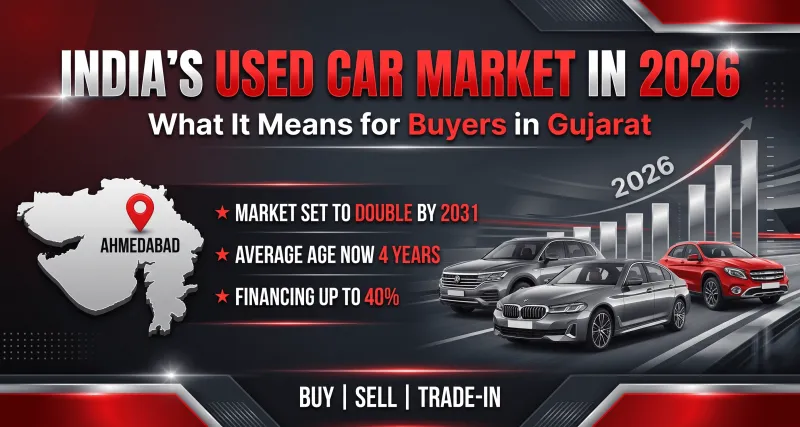
About $70 billion ($68 to 78 billion range) |
Redseer, April 2026 |
|
Annual used car sales, FY26 |
About 6 million units |
Redseer, April 2026 |
|
Projected annual sales, FY31 |
9 to 10 million units |
Redseer, April 2026 |
|
Expected growth of organised market, FY27 |
7 to 9% |
Crisil Ratings, August 2026 |
|
Used to new car sales ratio |
About 1.4 today, projected 1.7 by FY31 |
Redseer, April 2026 |
|
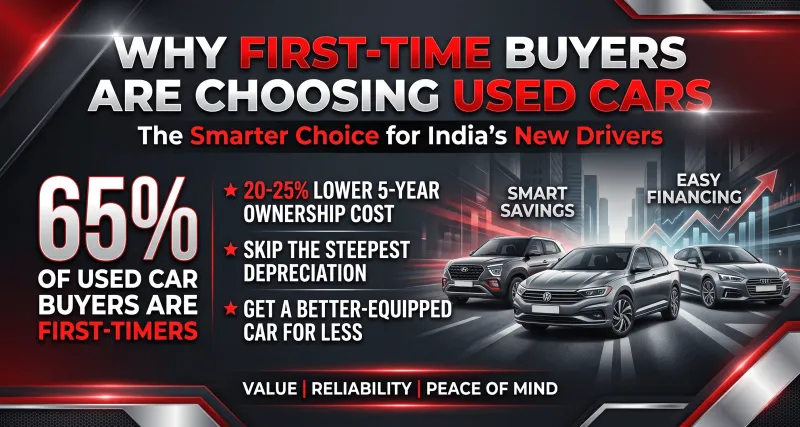
Buyers who are first-time car owners |
Nearly 2 in 3 |
Crisil Ratings, August 2026 |
|
Average age of a used car sold |
About 4 years (over 8 years a decade ago) |
Crisil Ratings, August 2026 |
|
Used car finance penetration, FY31 |
Up to 40% |
Redseer, April 2026 |
India is currently the fifth-largest used car market in the world. Redseer expects it to become the third-largest by the end of the decade, behind only the US and China.
Redseer projects the used car market will nearly double in value, from about $35 billion in FY26 to about $70 billion by FY31. Volumes are expected to grow 8 to 11% a year, while value grows faster, at 14 to 18% a year.
The gap between those two numbers tells its own story. Buyers are not only buying more used cars, they are buying better and more expensive ones. Redseer points to rising incomes and premiumisation as key reasons.
What it means for you: More cars are changing hands, so there is more choice. Premium and luxury models that were once rare in the pre-owned market are now far easier to find.
This is the most important shift for buyers. According to Crisil, the average used car sold today is about four years old. A decade ago it was more than eight.
Redseer explains why: owners are replacing their cars faster. Replacement cycles are shrinking from 7 to 8 years down to 4 to 5 years, and the share of cars aged 0 to 3 years in the used market is growing.
What it means for you: You no longer have to settle for an old, tired car to save money. A 3 to 4 year old car with modern safety features, connected tech and plenty of life left is now a normal purchase in the pre-owned market.
Redseer expects utility vehicles to grow from 12 to 16% of used car sales in FY21 to 19 to 22% by FY31. Hatchbacks are expected to slowly lose share, mirroring what has already happened in the new car market.
What it means for you: Demand for used SUVs is strong, so good ones sell quickly. If you want a specific SUV, it helps to tell a dealer early so they can alert you when the right car arrives.
Redseer reports that NBFC loan sanctions for used cars have scaled sharply, and it expects financing penetration in the used car segment to reach up to 40% by FY31. Crisil also lists wider financing options as a key support for demand.
What it means for you: A used car loan is easier to get than it was a few years ago, and you can spread the cost through EMIs. Compare the interest rate, tenure and processing fee before you sign, and make sure the lender's name is recorded correctly on the RC.
The used car market is still mostly informal. Crisil estimates organised players account for around 26% of used car sales. Redseer data shows nearly 80% of transactions still go through the unorganised segment, and only about 40% of buyers say they would recommend their buying experience.
The common problems are unclear vehicle history and quality checks that are far from standardised. Redseer expects organised players to grow to nearly 30% of the market by FY31, mainly by offering inspection, refurbishment, financing, warranty and documentation support.
What it means for you: Where you buy matters as much as what you buy. A private deal can look cheaper on paper but leaves you carrying the risk of hidden accident damage, a tampered odometer or a pending loan on the car.
Under the GST changes notified in September 2025, GST on eligible small new cars was cut from 28% to 18%, while large cars, SUVs and luxury vehicles moved to a 40% slab. New car prices fell, and used car prices followed. Industry players reported a correction of about 5 to 7% in used car prices, which they see as a lasting reset rather than a short dip.
A useful detail most buyers do not know: when you buy from a registered dealer, the dealer pays GST only on its margin (the difference between its buying and selling price), not on the full value of the car.
What it means for you: Used car prices today are more closely aligned with new car prices than they were before the reset. That makes comparing a used car against its new equivalent fairer and simpler.
Put together, the reports point to a few practical rules for anyone buying a used car in Ahmedabad, Gandhinagar, Vadodara, Surat or anywhere else in the state:
Kamdhenu Cars is an organised pre-owned car dealer with showrooms on S.G. Highway (Makarba) and in Naranpura, Ahmedabad. Every car is built around the problems the industry reports describe:
Browse used cars or premium cars in Ahmedabad, or read where to buy a reliable used car in Gujarat.
How big is India's used car market in 2026? Redseer Strategy Consultants values India's used car market at about $35 billion in FY26, with around 6 million cars sold a year. It projects the market to reach about $70 billion and 9 to 10 million units a year by FY31.
Are more people in India buying used cars than new cars? Yes. Redseer puts India's used to new car sales ratio at about 1.4, meaning roughly 14 used cars are sold for every 10 new cars. It expects this ratio to rise to about 1.7 by FY31.
How old is the average used car sold in India? Crisil Ratings estimates the average used car sold today is about four years old, compared with more than eight years a decade ago.
Did used car prices fall after the GST change? Industry players reported used car prices corrected by about 5 to 7% after the September 2025 GST changes reduced new car prices.
Is it safer to buy a used car from a dealer in Ahmedabad? An organised dealer typically offers inspection, reconditioning, documentation support and, in some cases, a buyback guarantee. These reduce the main risks of private deals, such as hidden accident damage or pending loans.
Nov 19 - 2026
Nov 19 - 2026

Nov 04 - 2026

Nov 04 - 2026
